The Acropolis Museum in 2026: What You Actually Need to Know
I’ve been to a lot of archaeology museums. Most of them feel like storage units with labels. The Acropolis Museum is genuinely different — and I don’t say that lightly. Built directly over an ancient Athenian neighborhood (you can see the excavation through glass floors underfoot), the building itself earns its keep before you’ve seen a single exhibit. But you still need to plan properly, because showing up without a ticket on a July morning is a special kind of misery.
Tickets in 2026: What You’ll Pay and Where to Buy
Standard adult admission runs €15 in peak season (April through October). Off-season drops to €10. Under-18s from EU countries get in free. Students with valid ID from EU institutions also enter free — bring the card, they do check. First Sunday of each month from November through March is free for everyone, which sounds great until you realize every other person in Athens has the same plan.
Book online. Seriously. The ticket office queue on a busy morning can eat 45 minutes of your day. The official booking portal at theacropolismuseum.gr lets you lock in a timed entry slot. You don’t need to arrive exactly on the dot, but having that booking gets you through the fast lane at the entrance.
If you want a guided experience bundled with your ticket, Viator and GetYourGuide both list combo tours that pair the museum with the Acropolis hill itself — useful if you want someone to connect the dots between what you’re looking at in the display cases and what those objects looked like in context up on the rock.
Opening Hours for 2026
- Monday: 9am – 5pm
- Tuesday to Sunday: 9am – 8pm (Fridays until 10pm in summer)
- Last entry: 30 minutes before closing
Friday evenings are genuinely underrated. The museum stays open late, the tour groups have mostly cleared out, and if you time it right you can catch the light changing over the Acropolis through those enormous glass walls on the top floor. Get there around 7pm, museum is half-empty, view is electric.
The Exhibits: What’s Actually Worth Your Time
The Ground Floor: Ancient Athens Under Your Feet
Before you even reach the escalators, stop and look down. The glass floor panels over the excavated settlement are easy to walk past when you’re rushing, but spend five minutes here. You’re standing above houses and streets that were occupied for a thousand years. The artifacts pulled from this site — ceramics, tools, everyday objects — are displayed along the edges. Grounding yourself here makes the whole visit make more sense.
The Archaic Gallery
Second floor. This is where the museum gets serious. The Moschophoros — the Calf-Bearer, a man carrying a calf on his shoulders carved around 570 BC — stopped me cold the first time I saw it. The smile carved into marble that old has no right being that expressive. The Peplos Kore is here too, still wearing faint traces of original paint if you look closely under the lighting. These pieces predate the Parthenon by a century and they’re extraordinary.
The Parthenon Gallery (Top Floor)
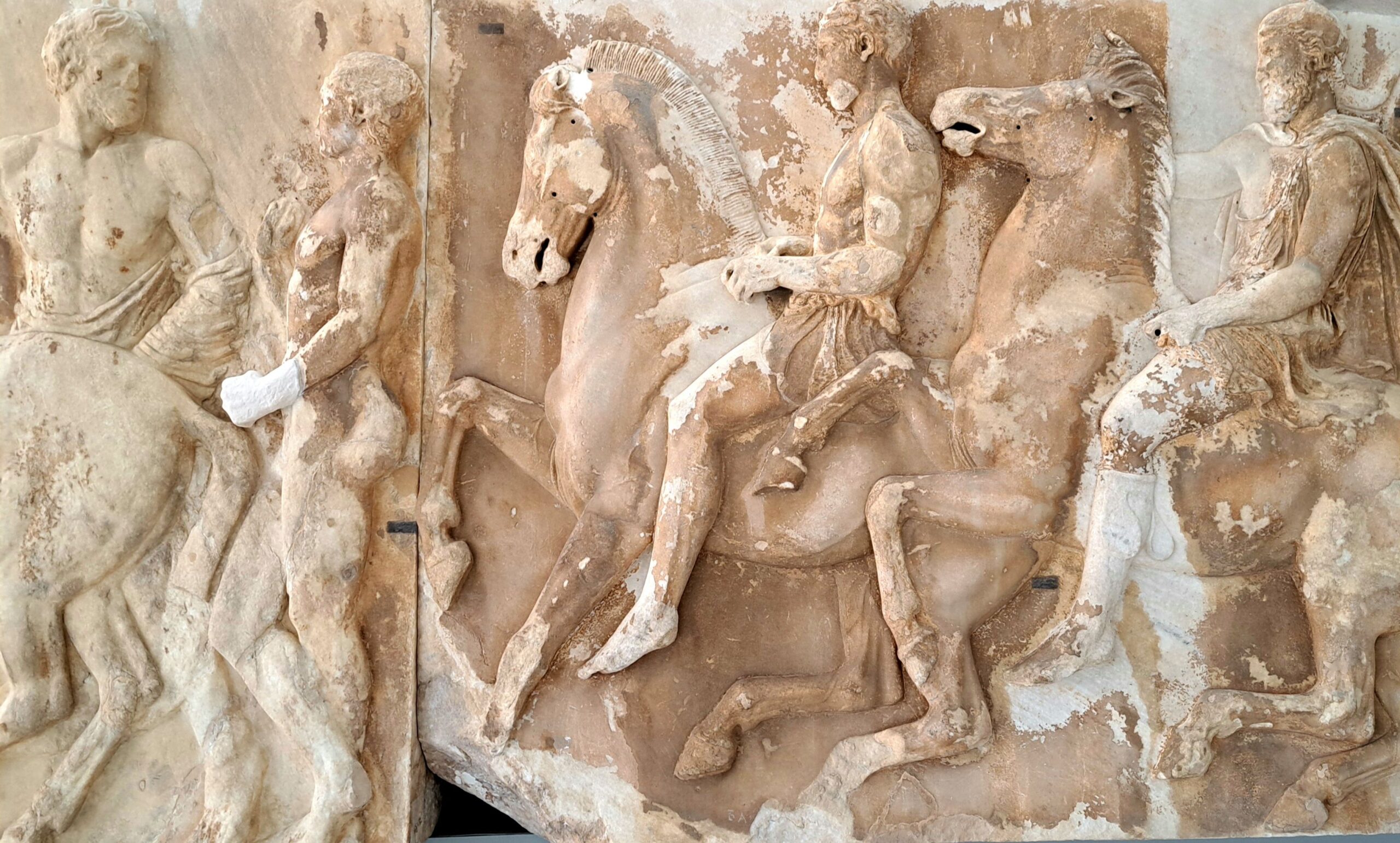
This is the reason the museum exists. The entire top floor is a glass-enclosed gallery oriented at exactly the same angle as the Parthenon itself on the hill above. On three sides, the original marble frieze panels — the ones Athens still has — are displayed at eye level, interspersed with high-quality plaster casts of the sections currently held in London’s British Museum. The contrast is the point. You see the original golden-honey marble next to white plaster and understand immediately what the ongoing repatriation argument is about. It’s not subtle, and it’s not meant to be.
The metopes depicting the battle between Lapiths and Centaurs are on the south side. Budget at least 30 minutes just for this floor.
Is a Guided Tour Worth It?
Honest answer: it depends entirely on how much background you’re bringing with you. If you know your Pericles from your Pheidias and can tell a metope from a triglyph, the free audio guide (available at the entrance desk) is sufficient. If ancient Greek architecture is genuinely new territory, a live guide changes the experience dramatically. A two-hour guided museum tour booked through GetYourGuide runs roughly €35–€50 per person including entry. The guides who specialize in this building — not generic Athens tour operators — are the ones worth finding. Look for small groups, eight people maximum.
The Museum Café: Actually Do This
The restaurant on the second floor has a terrace with a direct line of sight to the Acropolis. Coffee here runs about €4–€5, which is Athens café pricing, not tourist trap pricing. The food is decent Greek standards — nothing you’d travel for on its own — but sitting there with a Greek coffee looking up at the Parthenon is one of those simple experiences that actually delivers. Go late morning before the lunch rush, or after 3pm when it quiets down.
Practical Tips for Your Visit
- Wear comfortable shoes. The glass floor panels on the ground level are slightly uneven and slippery in spots.
- The museum is fully air-conditioned, which in an Athenian August is not a small thing. Plan accordingly.
- Photography without flash is allowed everywhere. No tripods.
- The gift shop has genuinely good reproductions — some of the ceramic pieces run €20–€60 and are made by local craftspeople, not mass-produced imports.
- Getting here: the Acropolis metro stop (red line, M2) puts you a five-minute walk away. Don’t take a taxi — traffic on Dionysiou Areopagitou street is a nightmare by 10am.
🏛 Ready to Book?
Browse verified Athens tours — trusted by over 3.5 million travellers worldwide.
Search Tours on Viator →We earn a small commission at no extra cost to you.
Browse verified Athens experiences — instant confirmation, free cancellation on most tours.
Search Tours on GetYourGuide → We earn a small commission at no extra cost to you.Frequently Asked Questions
More Things to Do in Athens
Beyond food — top-rated experiences with free cancellation & instant confirmation.
Related Articles

Best Day Trips from Athens 2026: Ancient Sites & Islands
Updated June 2026: We’ve just returned from testing the summer ferry schedules to the…

Athens Food Tours: Taste the Best of Greek Cuisine 2026
Updated June 2026: We’ve just wrapped up our spring tastings across Plaka and Psyrri,…
Epidaurus Day Trip from Athens 2026: Ancient Theatre & Sanctuary of Asclepius
Planning an Epidaurus day trip from Athens is one of the best decisions you…